Dan David Foundation · 2026 · Prize ceremony & social media

On Matthew Champion, and the first thing the burned abbey chose to restore.

A film built inside a shadow box. Lightning takes the Abbey of Averbode in 1499, and among the very first things the monks pay to replace is the clock — because it did not only tell the hour, it sang it. The score is built on a recording by Matthew Champion and his ensemble.

Client
Dan David Foundation
Subject
Prof. Matthew Champion
Direction
Daniella Koffler
Animation
Moofa Animation Team
Year
2026
Kind
Ceremony film
The subject

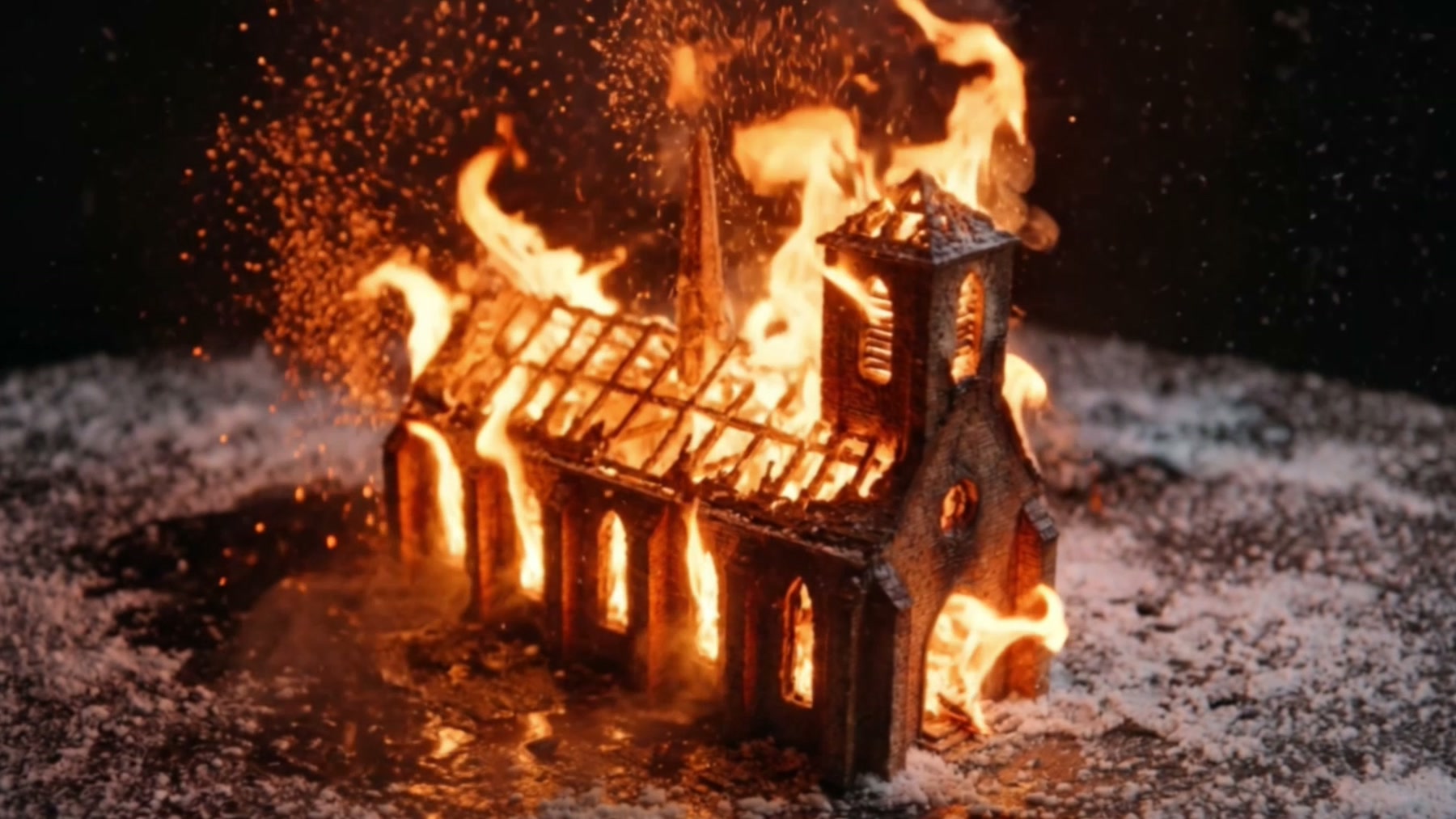
It is the night of Friday 24 October 1499. Thunder is moving over the Abbey of Averbode in the southern Low Countries, and at eleven o’clock — as the bells toll to wake the brothers for Matins — lightning strikes the abbey church. The fire takes bells, relics, stalls, paintings, the organ, a precious bible.

While the ashes are still warm, the abbey begins to rebuild. And among the very first things it pays for is a new clock. The account books survive, and they are specific: payments to bell-founders who sifted the ashes for salvage metal, and to clockmakers who did the repairs. The same records note what the clock played on its bells — on the hour, Sancti spiritus adsit nobis gratia; on the half hour, a chant in honour of the Virgin.

That is Champion’s argument in one object. Medieval and early modern societies are usually described as timeless. They were nothing of the kind. They organised time, measured it, argued about it and paid for it — and mechanical sounding clocks like Averbode’s spread across Europe, through the reformations, across the Atlantic, and into Asia with the missionaries.

A shadow box, and one rule inside it

The whole film happens inside a shadow box. Everything in it is physically real — the brass bells on their iron chains, the exposed clock mechanism, the manuscript pages pinned to the walls, the ash on the floor, the single candle. Everything except the people. The monks, the bell-founders and the clockmakers are flat paper cut-outs, drawn after illuminated manuscripts: hand-coloured, ink-outlined, two-dimensional figures standing in a three-dimensional world.

Between scenes the film travels through the mechanism itself, among the escapement wheels and the spring, and never passes the same gear twice.

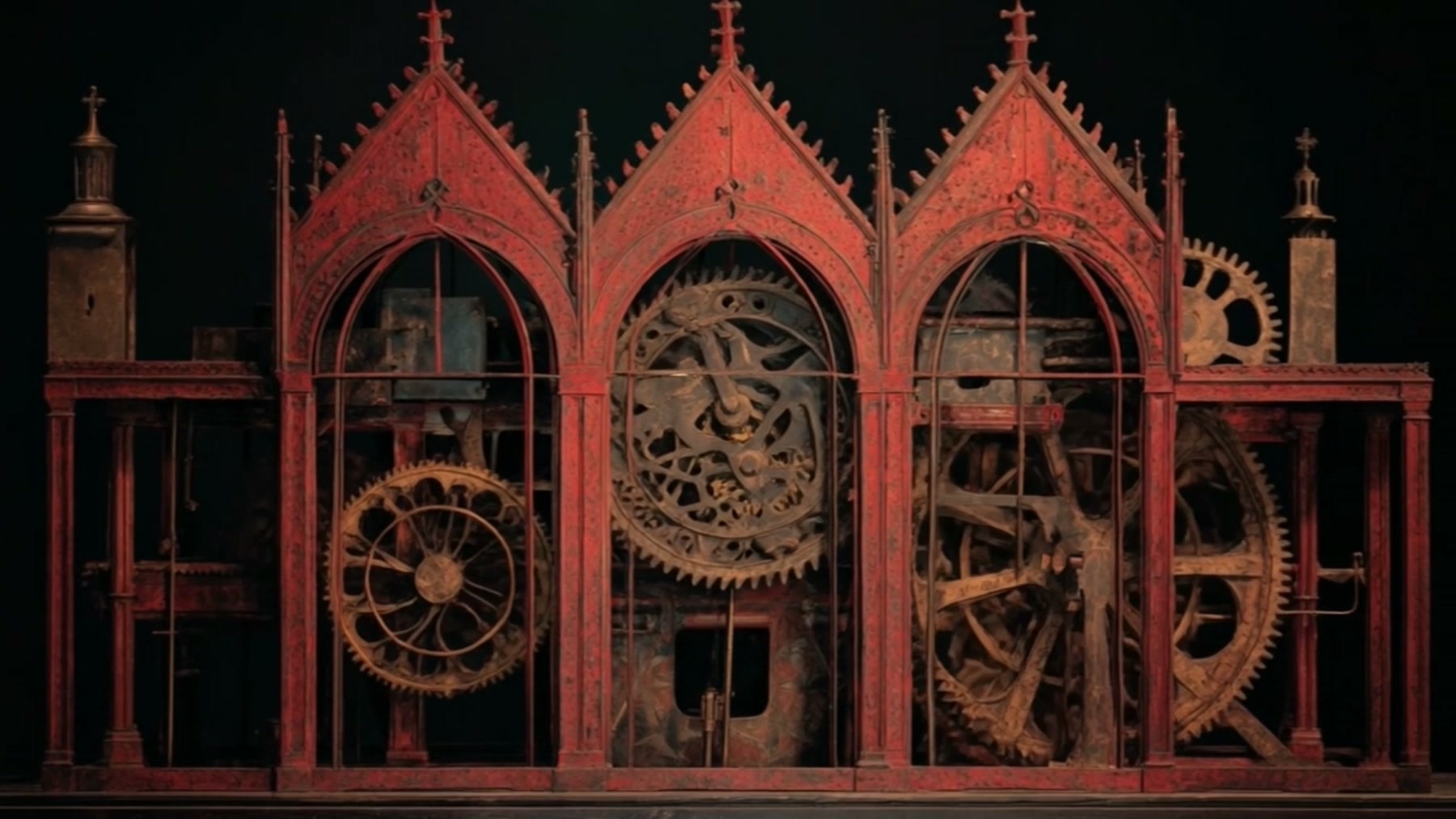
Film still: a medieval iron abbey clock mechanism, gothic cage and great gear wheels, floating in darkness
The opening

A machine somewhere between an engine and a cathedral.

The film opens on the mechanism itself, floating in the dark with no room around it — iron tracery, architectural columns, enormous wheels turning slowly. It is held long enough to be looked at properly, the way you stand in front of something in a museum that stops you. Then the camera moves forward, between the wheels, and comes out the other side inside the box.

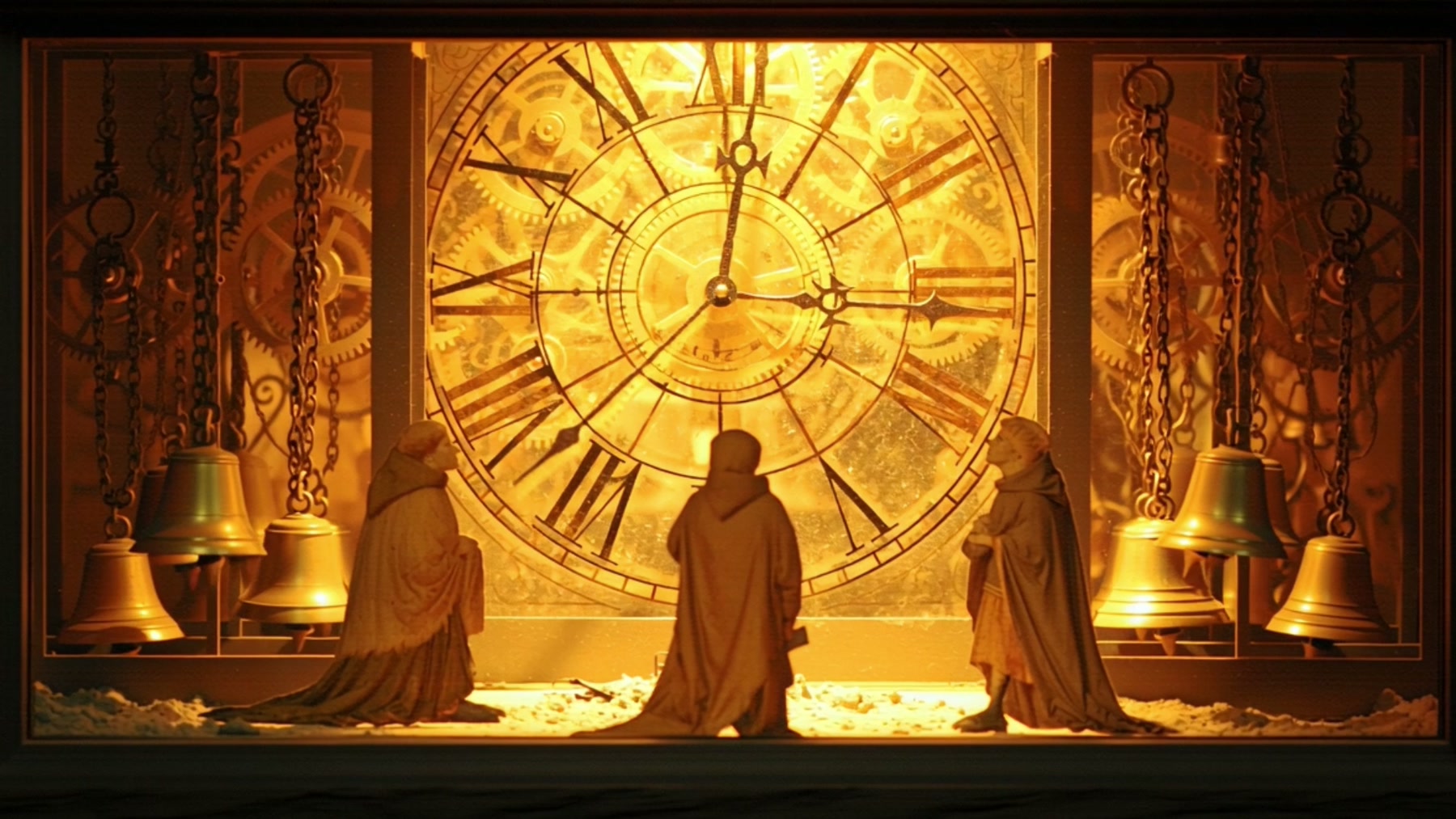
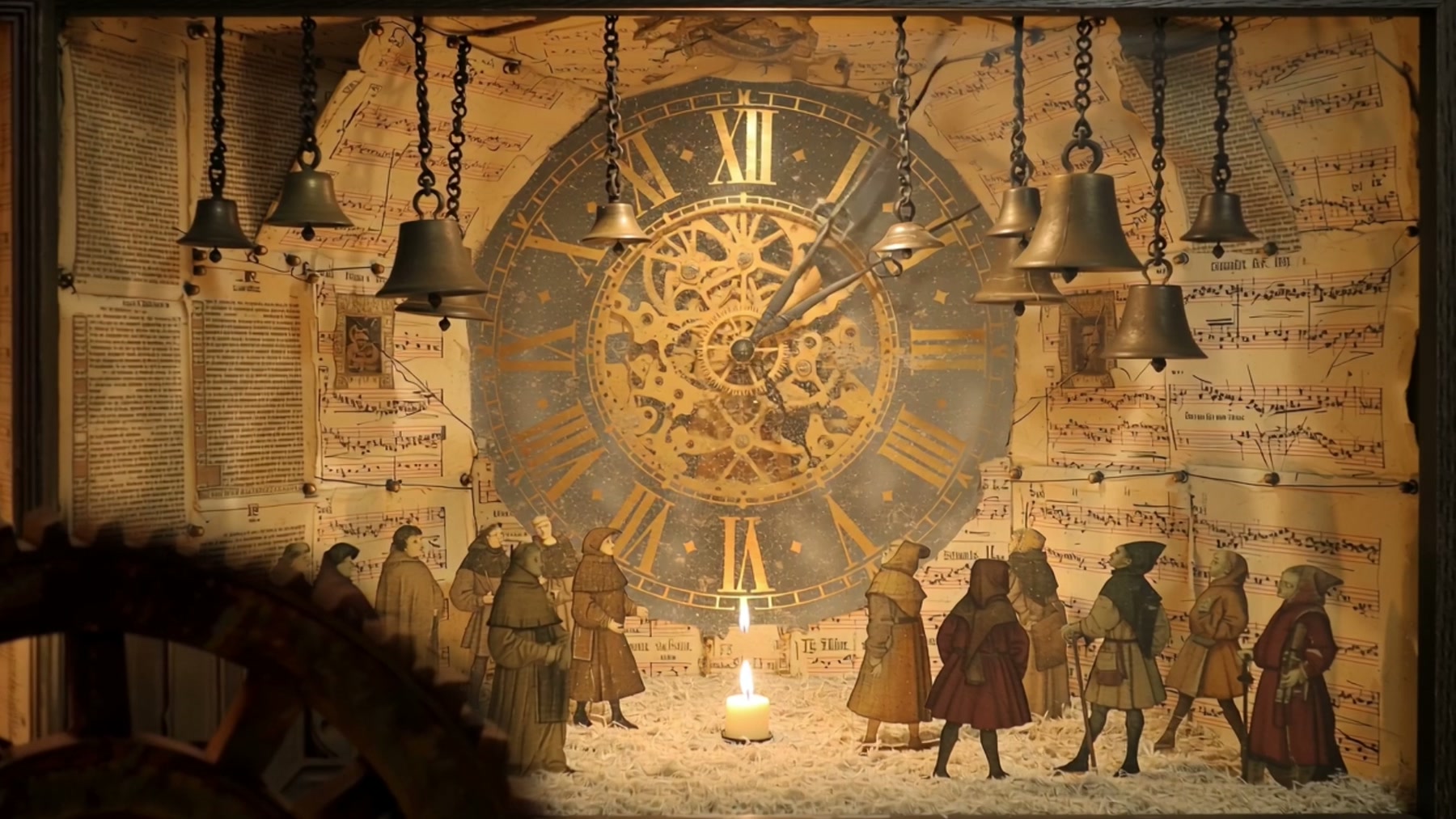
Film still: the inside of a shadow box, a skeleton clock face on the back wall, brass bells on chains, manuscript pages pinned around, a candle lit below
The night

Eleven o'clock, and the abbey is still whole.

Inside the box: the skeleton clock on the back wall with its gears showing through the dial, bells hanging on iron chains, abbey records and Gregorian notation pinned across the walls. A single flat monk stands at the base with a candle at his feet, looking up. The hands read just before eleven.

Film still: a model of a Gothic abbey church burning, saturated orange flames against deep indigo
The strike

The one moment the box cannot hold.

Lightning hits while the bells call to Matins. It is the only scene that leaves the box entirely. When the fire stops, silence falls, and the boxes return to the film.

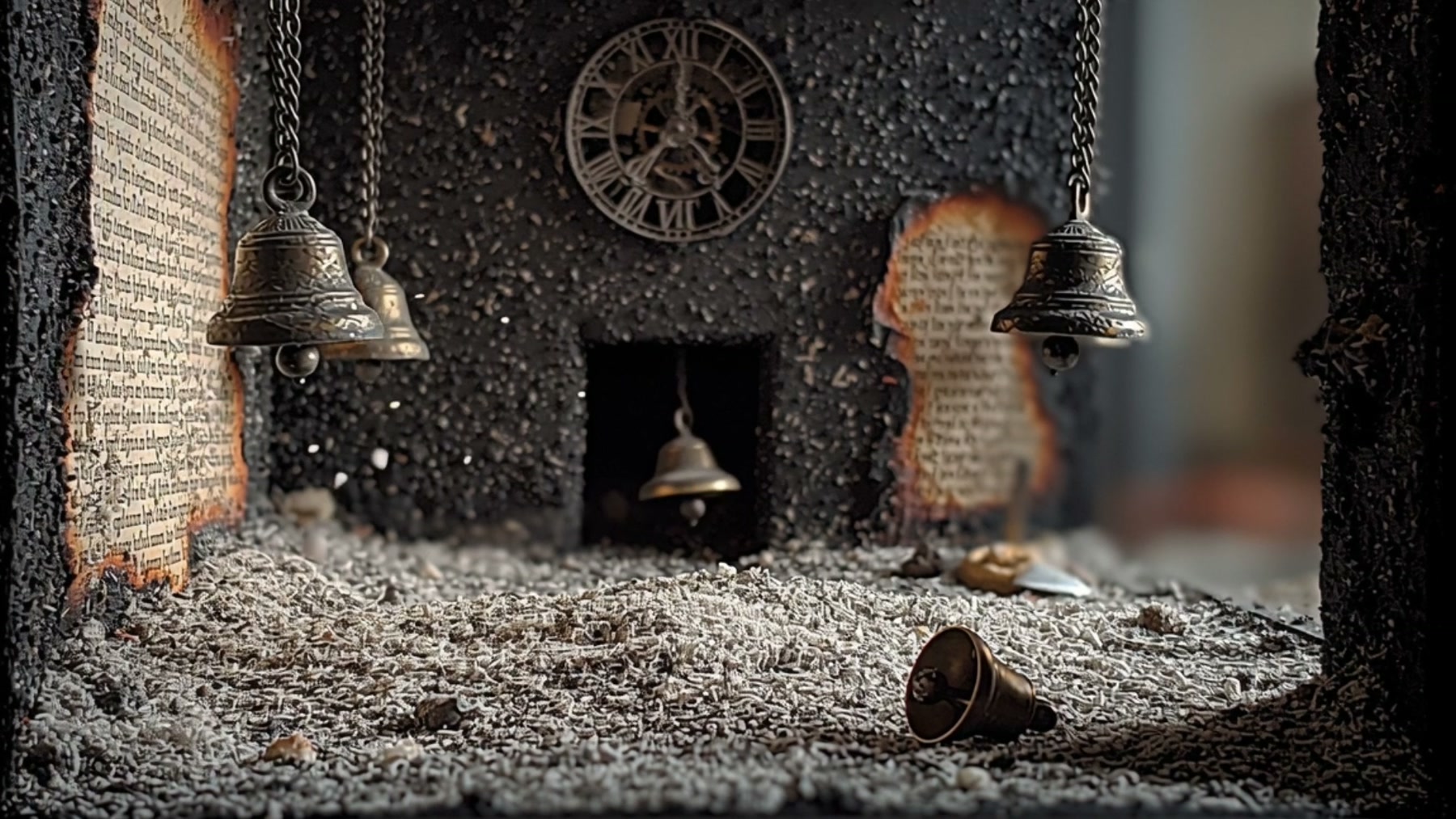
Film still: the box interior in ash-grey and bone-white, bells hanging still, a fallen bell lying in deep ash on the floor
After

The clock stops, so the world stops.

The orange is gone and everything is ash-grey. The manuscript pages are curled at their burnt edges, the bells hang without moving, the candle is out, and a fallen bell lies on its side in ash that keeps falling like snow that will not stop. The clock's hands are frozen at eleven. In this film the figures move only when the mechanism moves — so nobody moves at all.

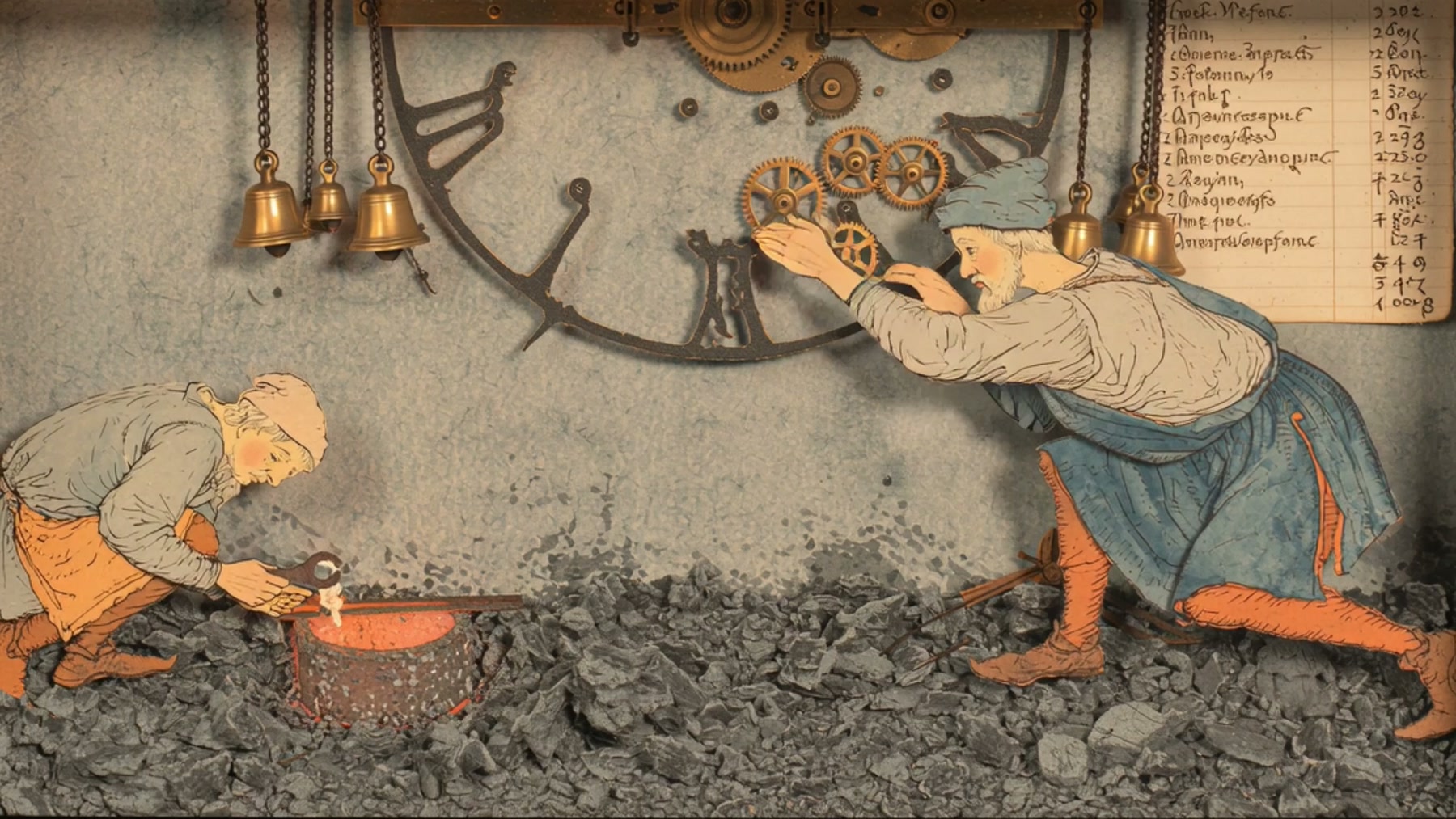
Film still: flat paper cut-out craftsmen at work in the box, one crouched over a glowing crucible in the ash, another working at the clock gears
The rebuilding

The people the account books name.

New figures arrive, and they are not monks. Bell-founders and clockmakers, drawn after manuscripts, doing exactly the work the records describe — one crouched over a crucible where salvaged bell metal is beginning to glow, the first warmth earned back from the fire; another with his hands on the gears. Behind them, fresh pages are pinned up: names, amounts, dates. The records name them and the figures embody them.

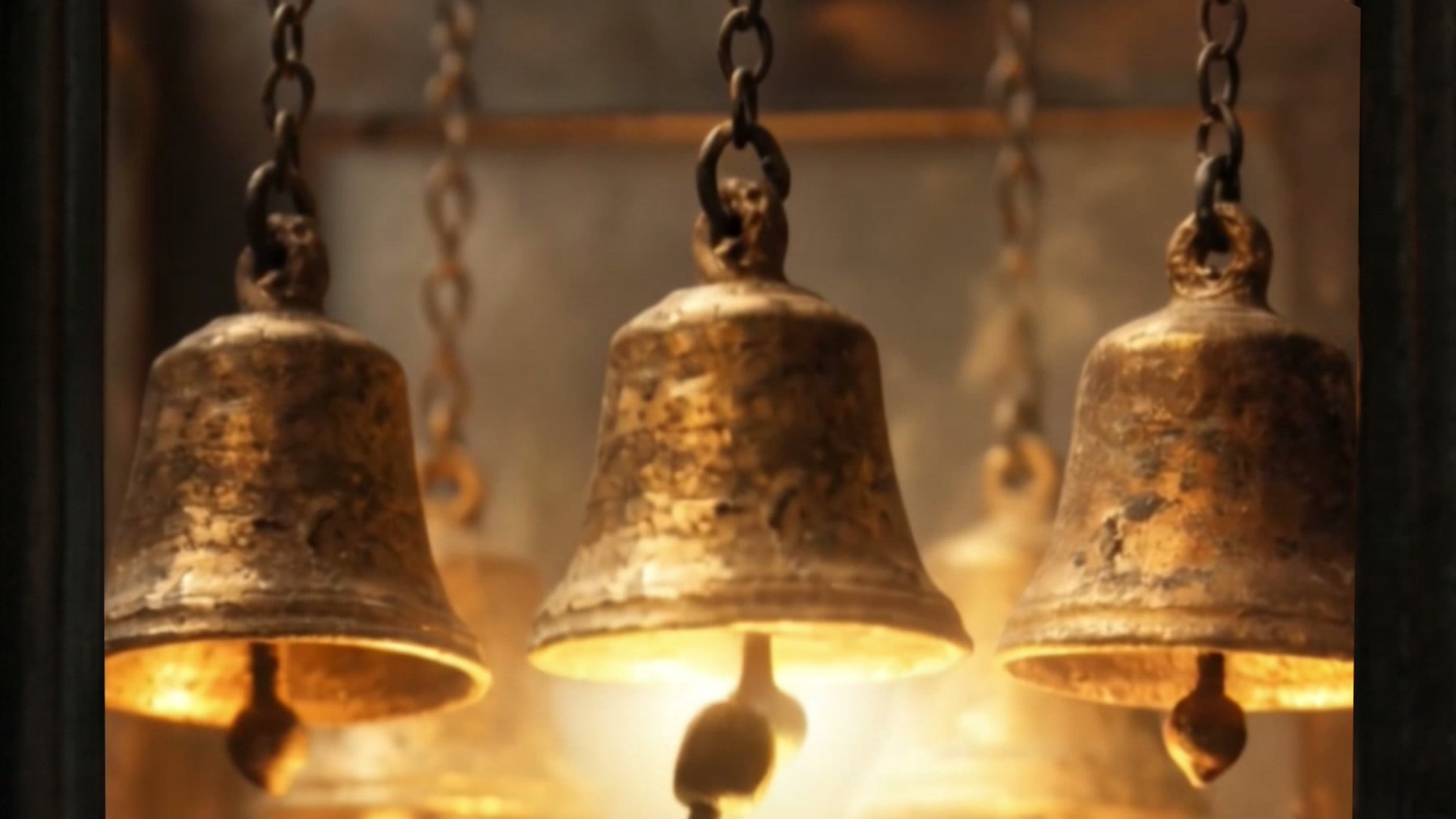
Film still: brass bells swinging on iron chains, ash particles shimmering in raking amber light
The chime

The clock sings.

When the clock comes back, it does not only tell the time. It sings. This is the moment we hear Matthew Champion and his ensemble singing the very song the clock played on its bells.

Film still: the clock face fully lit and turning, gears visible through the dial, flat monk figures below looking up
And time restarts.

Gold through the dial, and the figures look up.

The clock comes back to life. Every wheel turns, and the hands return to their proper pace. The monks below lift their painted faces toward it.

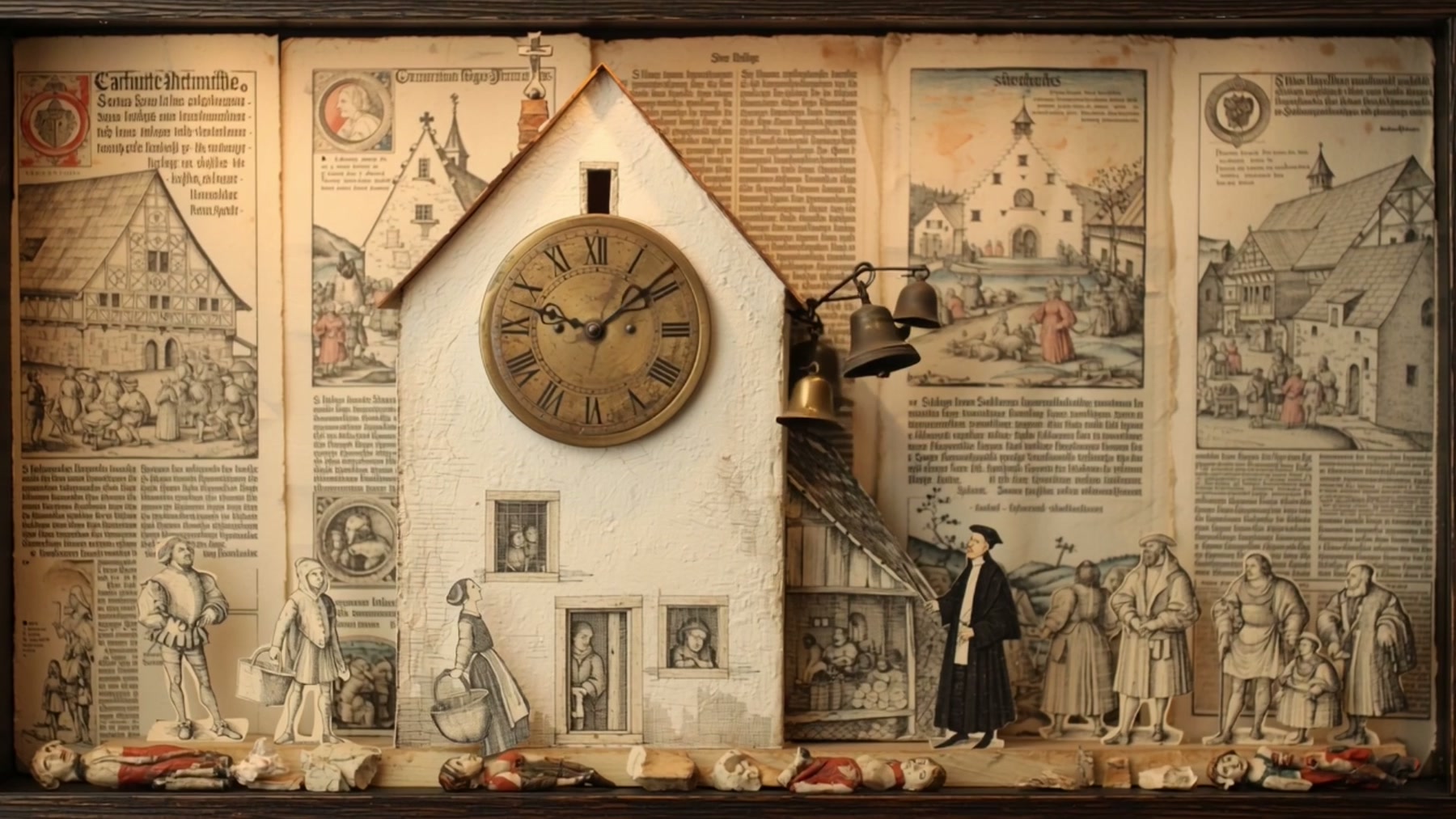
Film still: a Reformation-era shadow box, a whitewashed civic clock tower, broadsheets on the walls, flat townspeople below
Where did the clocks go?

They survived the reformations and went out into the world from the abbey: with the missions to South America, China and Japan.

The film follows the object outward, and each stop is built as its own box. Here the religious statues are down and the whitewash is up — but the mechanism stayed. The clock simply changed owner: it now belongs to the city rather than the abbey, and the figures below it are burghers rather than monks.

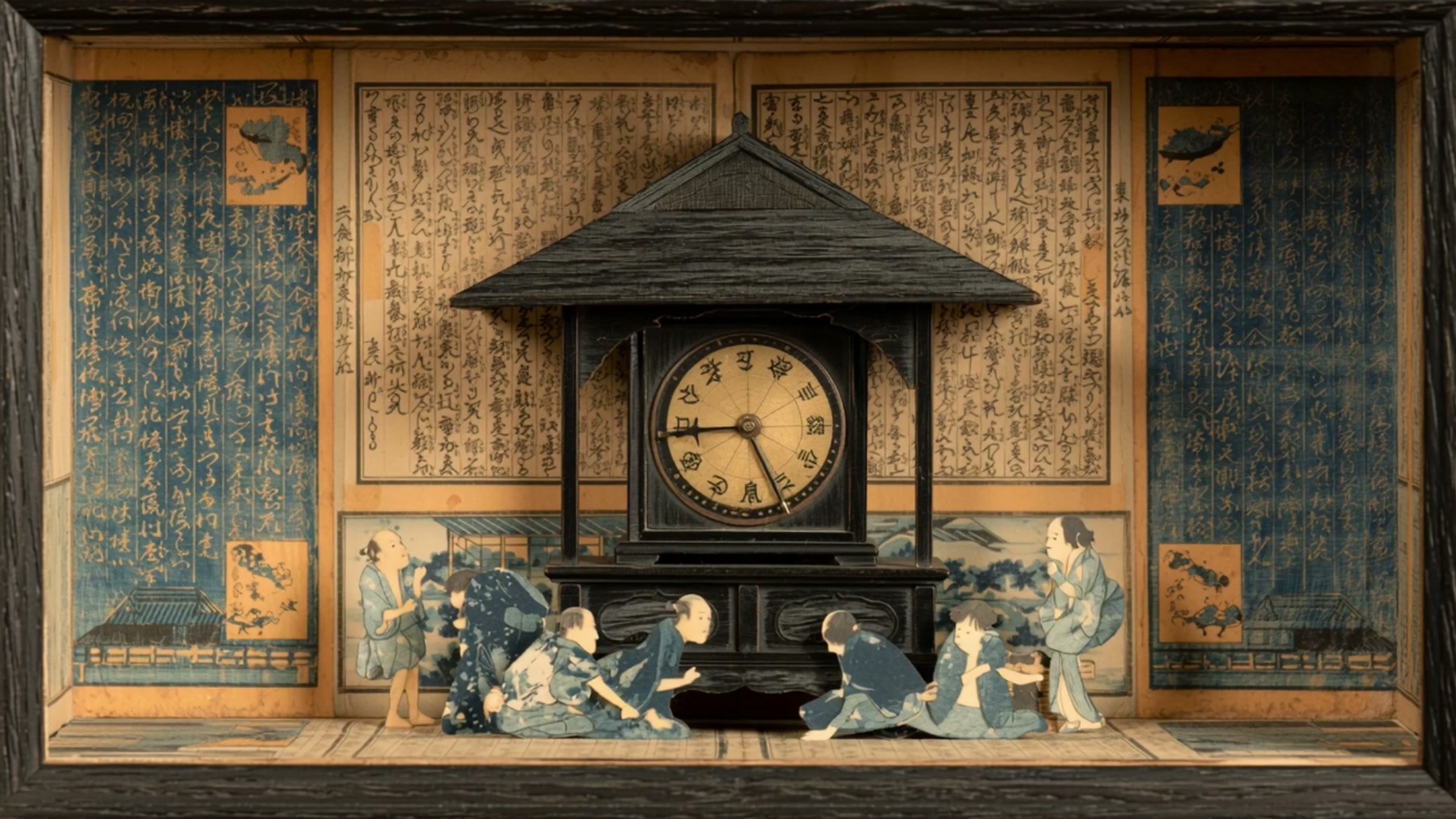
Film still: a shadow box with an ornate European bracket clock at its centre, Chinese calligraphy panels and red seals around it, flat Ming court figures leaning in
Into Asia

And then they reached new worlds.

Missionaries carried the technology across the Atlantic and into Asia, and the clock appears at the Ming imperial court: a European clock at the centre of a Chinese picture, with two layers of cut-out figures meeting around it.

The score

Matthew Champion is a musician as well as a historian, and the score is based on a recording of his: the voices in it are Cantus Temporum, the early-music ensemble he founded and leads, and the song is the one the abbey’s clock sang. Our composer, Eitan Shefer, wrote the score around that musical theme. In this film you can see clearly what we mean when we say that both the design and the score are built from the film’s own sources.

About the laureate

Matthew Champion is a historian of premodern temporalities — how people experienced, perceived and shaped time. The Dan David Prize selection committee praised “Champion’s original and imaginative work that demonstrates how time is both given to and shaped by individuals, as well as noting the way he brings his lived experience as a musician to bear on his deep engagement with the sounds of life and the pluralities of time.”

The Dan David films

Each year the Foundation chooses, with the laureate, the subject of the film they are honoured for, and we turn it into script, image and motion. The laureate sees it for the first time on the evening of the prize — on the big screen, in a room full of people who have come to honour them. Afterwards the films go out on social media, YouTube, Facebook, LinkedIn and more, and on the Foundation’s own site, beside the committee’s reasoning and the laureate’s interview, and some laureates carry them into their own classrooms, to show what it is they work on.
Get in touch

Have a prize that deserves this kind of care?

Tell us about it →